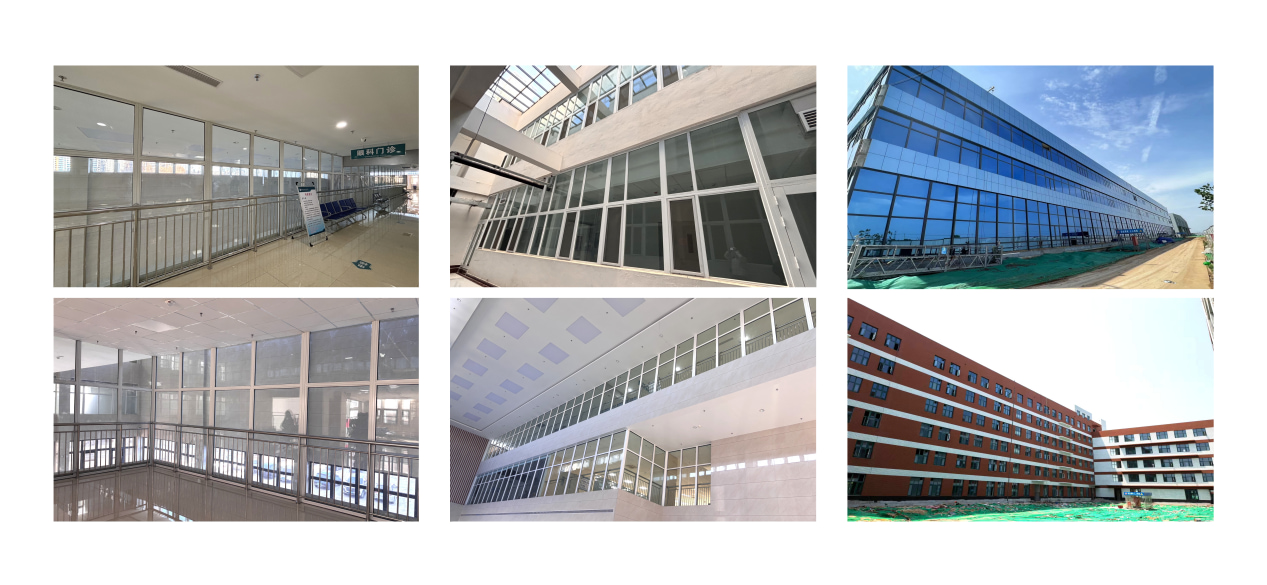

Application Practice of Fireproof Window in Multi-scenario-Building a Strong Defense Line of Building Safety
As a vital component of building fire protection systems, fire-resistant windows must not only meet stringent fire resistance standards but also be customized to suit the functional requirements of different architectural settings. From densely populated public buildings to heritage buildings preserving historical charm, from high-risk industrial facilities to livable residential homes, these adaptable solutions safeguard the safety of diverse spaces with their versatile functionality.
1. Fire Protection Zoning and Segmentation in Buildings
When firewalls or fire-resistant partition walls are used for zoning within a building, if windows are required on the walls, fire-resistant windows must be installed. This is commonly seen in atrium partitions of large commercial complexes, office area and equipment zone partitions in office buildings, and production area and storage area partitions in industrial plants.
2. Key Areas of High-Rise and Supertall Buildings
-External windows or skylights in smoke-proof and enclosed stairwells must meet the corresponding fire resistance rating requirements to ensure the safety of evacuation routes.
-Openings in building exterior walls: When the height of solid walls between upper and lower openings is insufficient, fire-resistant windows must be installed for fire protection, such as balcony windows in high-rise residential buildings.
-Inspection windows in equipment shafts (e.g., cable shafts, pipeline shafts) to prevent fire spread through vertical shafts.
3. Crowded places
Fireproof windows must be installed on both sides of evacuation routes and functional area partition windows in densely populated public buildings such as theaters, stadiums, airports, and high-speed railway stations.
4. Special Function Buildings
-Cultural heritage sites and historic buildings: During renovation, light-inlet windows and partition windows must be fitted with fire-resistant glass while preserving the original architectural character.
-Medical buildings: Partition windows in areas such as operating rooms and intensive care units (ICUs) must meet both fire resistance and hygiene requirements;
-Educational buildings: Fire-resistant windows must be installed on the exterior walls of school teaching buildings and laboratories, especially in high-risk areas such as chemistry laboratories.
5. Industrial buildings
Lighting windows in workshops, production areas, and hazardous material warehouses with fire hazards in industries such as metallurgy, chemical engineering, and precision electronics.