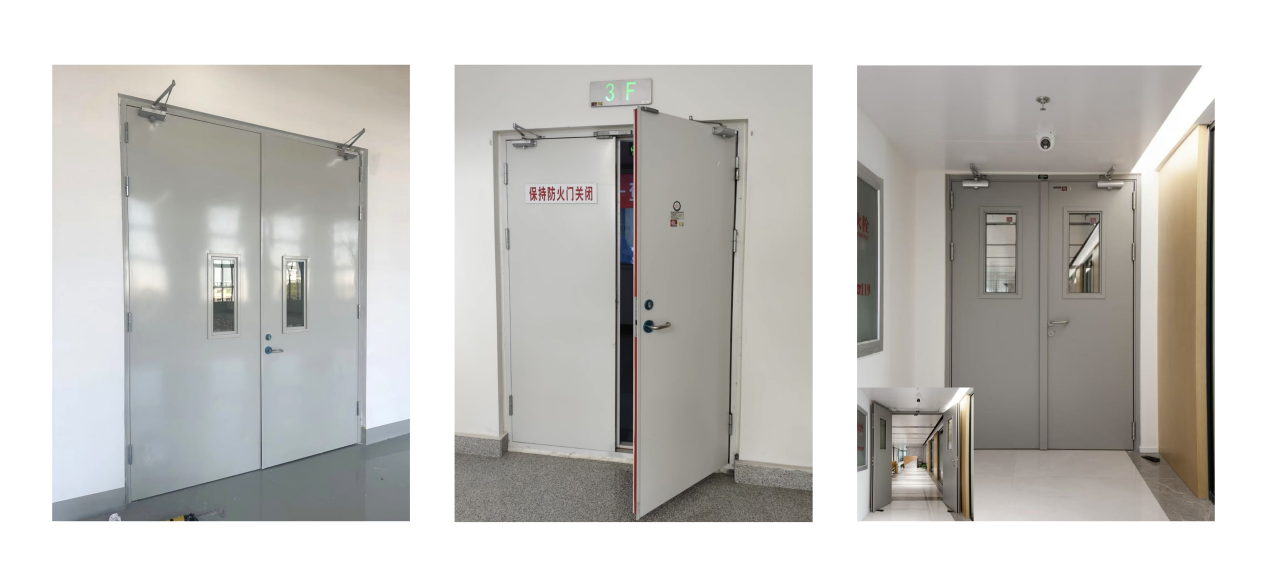

Scenario Customization, Protecting Building Safety: Fire Door Engineering
Fire doors are the core components of a building's passive fire protection system, and their selection and design must be deeply aligned with the functional attributes, user demographics, and environmental characteristics of the building. From densely populated transportation hubs to tranquil medical facilities, from retro historical buildings to high-efficiency industrial plants, customized fire door solutions establish robust safety barriers for diverse scenarios.
Fire doors must not only meet stringent fire resistance requirements but also balance operational efficiency with durability. In evacuation stairwells, equipment rooms, and dining area partitions, the project employs Class A steel fire doors with permanent operation, equipped with electromagnetic release devices and fire linkage systems. Under normal conditions, these doors remain open to ensure unimpeded access for passengers and staff. During a fire, the system triggers automatic door closure within 3 seconds, achieving 2.0-hour fire resistance integrity and thermal insulation to effectively contain smoke and flames. The door panels feature a wear-resistant, scratch-resistant fluorocarbon coating, engineered for high-frequency airport environments, setting a benchmark for fire safety in major transportation hubs.
1. Class A fireproof door
Applicable to core areas with high fire hazards requiring strict fire and smoke containment:
-Industrial buildings: partitions in specialized production/storage areas such as chemical plants, precision electronics workshops, hazardous material warehouses, fuel/gas boiler rooms, and electrical distribution rooms;
-Public buildings: critical equipment rooms in large commercial complexes such as fire pump rooms, ventilation and air conditioning machine rooms, and generator rooms; key medical areas in hospitals including pharmaceutical warehouses and operating rooms;
-Super high-rise buildings: Fire compartment partition walls and refuge floor separations in residential or office buildings exceeding 100 meters in height.
2. Class B fireproof doors
Fire doors, the most widely used in buildings, are designed to ensure the safety of personnel evacuation.
-Evacuation access points: doors of enclosed stairwells and smoke-proof stairwells in all types of buildings, as well as doors in the vestibule of fire elevators.
-Public buildings: school laboratories (chemistry/physics), backstage areas of theaters/athletics stadiums, evacuation corridor partitions in airports/high-speed rail stations;
-Civil buildings: individual unit doors in high-rise residential buildings (as required by local regulations), and corridor/functional area partitions in nursing homes/welfare institutions;
-Industrial buildings: Partition doors between production workshops and office/recreation areas.
3. Class C fireproof doors
Primarily used for vertical pipe wells to prevent fire vertical spread.
-Building shafts: Maintenance access doors for cable wells, pipe wells, smoke exhaust ducts, and waste chute shall be installed on each floor, with Class C fireproof doors installed for separation.