

Detailed Explanation of Fire Door/Window Classification: Materials, Advantages, and Applications
Jan.20.2026
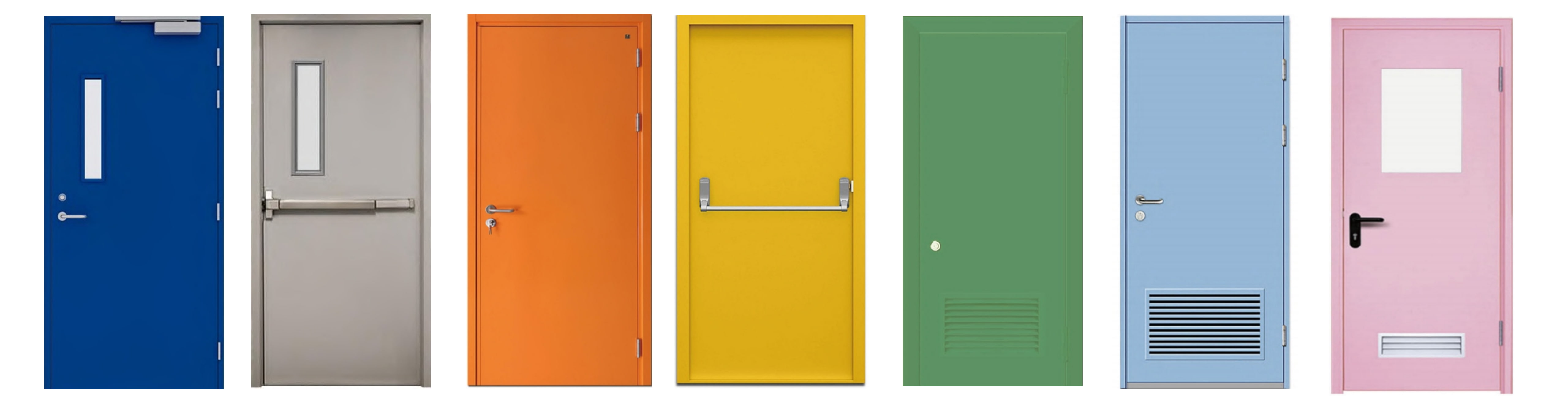
Steel fire doors are categorized into three types based on material: standard steel fire doors, stainless steel fire doors, and steel-wood composite fire doors. Each type has distinct advantages and characteristics, as detailed below:
Standard steel fire door (cold-rolled steel plate)
Core Advantages: High cost-performance ratio and excellent fire resistance stability. Cold-rolled steel plates undergo anti-rust treatments such as pickling and phosphating, with surface fireproof coatings or spray painting applied. They are resistant to rust at room temperature and can withstand high-temperature exposure for over 1.5 hours during fires (Class A), maintaining structural integrity while effectively blocking flames and smoke.
Suitable for commercial and engineering environments including shopping malls, factories, and office buildings, particularly in areas requiring stringent cost control and basic fire safety standards.
Stainless steel fireproof door (304/201 stainless steel)
Core Advantages: Exceptional corrosion resistance with dual excellence in aesthetics and durability. The 304 stainless steel material exhibits superior resistance to acids, alkalis, and moisture, making it suitable for humid or corrosive environments such as bathrooms, basements, and coastal areas. The surface can be treated with brushed or mirror finishes, offering refined appearance while combining fire resistance with decorative qualities.
Applicable scenarios: Hospitals, food factories, coastal residences, high-end commercial spaces, and other locations with stringent requirements for corrosion resistance and aesthetic appeal.
Steel-wood fireproof door (steel frame with flame-retardant wood panel)
Core Advantages: Balances texture with fire resistance. The internal steel frame ensures fire resistance, while the external flame-retardant wood (e.g., fireproof plywood) presents a natural wood grain texture with a warm tactile feel, making it more in harmony with home decor styles compared to pure steel doors, while also offering sound insulation.
Suitable for: Residential entry doors, villa interior doors, hotel guest room doors, and other civil applications requiring harmonious interior design.
Glass fire doors are classified by material and structure, with core differences in fire resistance, light transmission, and application scenarios. Their specific advantages are as follows:
Single-pane fire-resistant glass door
Core Advantages: Simple structure with high light transmittance (over 80%). Single-pane fire-resistant glass eliminates the need for composite layers, maximizing natural light retention. During fires, it blocks flames through its inherent high-temperature resistance (e.g., Class A fire resistance for 1.5 hours) and produces no sharp fragments upon breakage, ensuring high safety.
Suitable for: office building corridors, shopping mall display windows, exhibition halls, and other areas requiring unobstructed visibility with basic fire safety requirements.
Composite fire-resistant glass doors (e.g., laminated fire-resistant glass, insulating fire-resistant glass)
Core Advantages: Dual-effect fire-resistant and smokeproof, with multifunctional performance. The laminated layer adheres to glass fragments at high temperatures to prevent detachment while blocking the penetration of toxic fumes. The hollow structure of the composite glass further enhances thermal insulation and soundproofing, meeting higher comfort requirements.
Applicable scenarios: Hospital ward doors, hotel guest room doors, residential balcony doors, and other locations with additional requirements for smokeproofing, soundproofing, and thermal insulation.
Special fire-resistant glass doors (e.g., grouted fire-resistant glass, borosilicate fire-resistant glass)
Core Advantages: Exceptional heat resistance with prolonged fire endurance. The grouted glass is internally filled with fire-resistant fluid, which expands to form an insulating layer under high temperatures. Borosilicate glass exhibits strong thermal shock resistance, making it suitable for high-temperature environments and capable of maintaining structural stability in extreme fire conditions.
Suitable for: industrial plants, laboratories, airports, and other special areas with extremely high requirements for fire resistance rating and environmental adaptability.
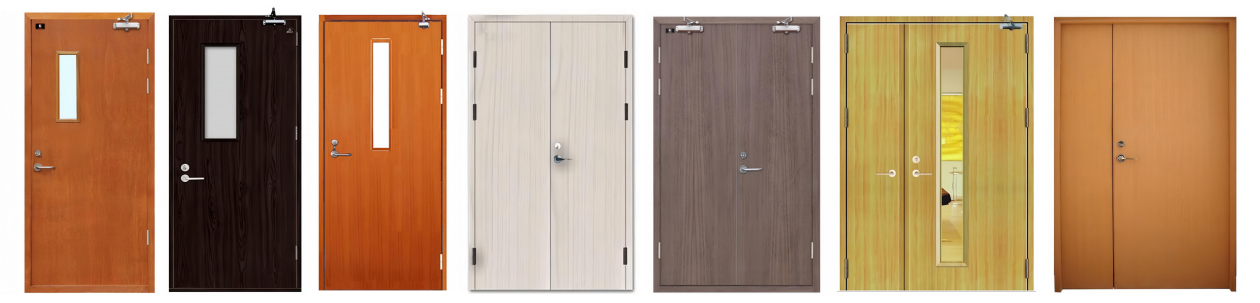
Wooden fire doors are categorized by their base material and processing techniques, with their core strengths lying in decorative appeal, environmental sustainability, and adaptability to diverse scenarios, as detailed below:
Flame-retardant solid wood fire door (made of natural solid wood)
Core Advantages: Premium texture with strong decorative appeal. Crafted from natural solid woods such as walnut and cherry, these products undergo deep flame-retardant treatment (e.g., flame retardant immersion) to preserve the wood grain and warm tactile sensation. They meet fire resistance standards (Class A fire resistance ≥1.5 hours) while offering excellent thermal insulation, eliminating the cold sensation associated with metal doors.
Suitable for: entrance doors of villas, interior doors of luxury residences, and Chinese-style hotel guest room doors, designed for natural aesthetics and fire safety compliance.
Flame-retardant plywood fire door (made of multi-layer plywood)
Core Advantages: High stability and excellent cost-performance ratio. The multi-layered plywood, after flame-retardant treatment, exhibits superior deformation and crack resistance compared to solid wood. The surface can be covered with wood grain paper, veneer, or painted, offering diverse designs at a lower cost than solid wood options. It also meets Class B/III fire resistance requirements.
Suitable for: standard residential bedroom doors, apartment common area doors, and small hotel guest room doors, balancing aesthetics with budget.
Eco-friendly paint-free wooden fireproof door (made of flame-retardant panels with a paint-free finish)
Core Advantages: Easy installation and eco-friendly. The base material is made of flame-retardant particle board or multi-layer board, with a surface coated with paint-free PVC film or wood veneer. No on-site painting is required, and it emits no formaldehyde odor. Ready for immediate use after installation, it combines fireproof and moisture-resistant properties, and is easy to clean daily.
Suitable for: mass installation in high-end apartments, interior doors for children's rooms, and office space doors with stringent environmental requirements, emphasizing efficiency and health.
Fire-rated windows are categorized by their frame-glass material combinations, with their core strengths lying in balancing scenario adaptability, protective performance, and practical functionality, as detailed below:
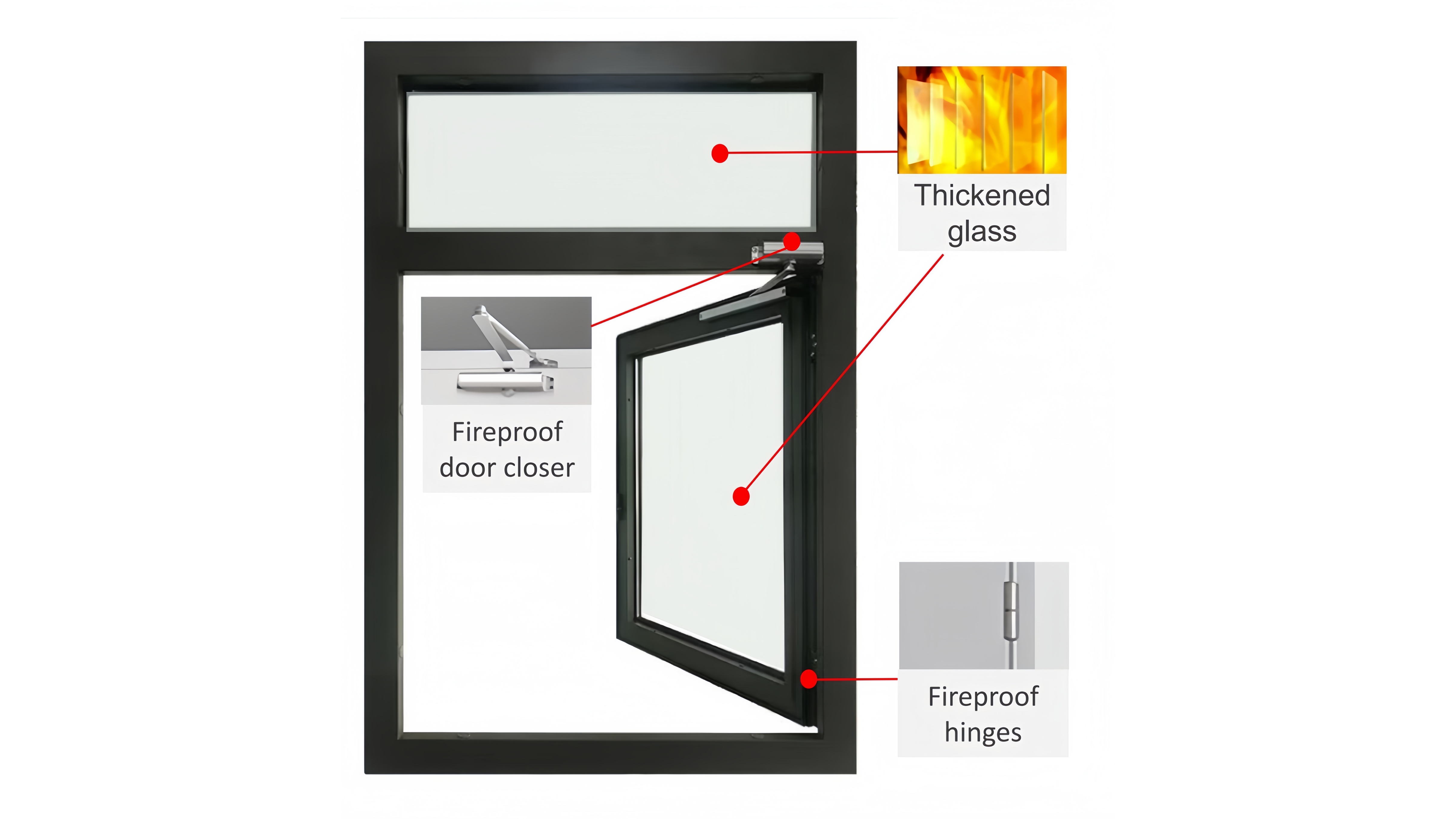
Steel fire-resistant window (frame: cold-rolled steel plate + fire-resistant glass)
Core Advantages: Robust structure with exceptional fire resistance. The cold-rolled steel window frames are treated with anti-corrosion coatings, demonstrating outstanding high-temperature and deformation resistance. When paired with single-pane or laminated fire-resistant glass, the overall fire resistance rating reaches Class A (≥1.5 hours), effectively blocking flames and smoke. Additionally, they exhibit superior wind pressure resistance, making them suitable for high-rise buildings or outdoor environments.
Suitable for: industrial plants, warehouses, office building exteriors, and evacuation routes in shopping malls, where structural stability and fire resistance ratings are critical.
Thermal break aluminum fire-resistant window (frame: thermal break aluminum profile + fire-resistant glass)
Core Advantages: Energy-efficient insulation with aesthetic appeal. The thermal break aluminum window frame features built-in thermal insulation strips to minimize indoor-outdoor temperature transfer. Paired with double-glazed fire-resistant glass, it delivers triple functionality: fire resistance, sound insulation, and thermal retention. The surface supports multi-color painting for modern interior design, eliminating the cold aesthetic of traditional steel windows.
Suitable for: residential balconies, exterior windows of high-rise apartments, and hotel guest room windows, focusing on residential comfort and fire safety compliance in civilian settings.